Showing posts with label Labour. Show all posts

Tuesday, September 27, 2011

No smoke

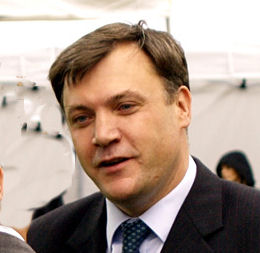
So Ed Balls thinks that he should suggest how we run the economy, does he?  This is the same person who was Gordon Brown's key adviser when the economy was being systematically run down under the last Labour Government.

Why would we put an arsonist in charge of the Fire Brigade?

Saturday, September 18, 2010

The next Labour Prime Minister


As we move into the last days of the Labour leadership contest, it's worth wondering who will be the next Labour prime minister.
The problem is that, I suspect, it will be none of the above.

I don't think anyone takes the candidacy of Andy Burnham or Diane Abbot seriously.  That leaves the two Milliband brothers and Ed Balls.

Ed Balls was Gordon Brown's closest advisor as he took Britain's economy from being the strongest In Europe to almost the weakest.  If he became the next Labour leader, the Tories would make hay with this.  As for the Milliband brothers, they have lacked political courage.  Where was Ed Milliband (a Blairite) when Tony needed him?  Why did David Milliband not challenge Gordon Brown for leadership of the party?

In short, the Millibands remind me too much of John Major, who was a decent man but an example of the Peter Principle.  Ed Balls was the architect of our current economic disaster and the others won't make it for one reason or another.

So where is the next Labour leader?  How do political parties recover from the kind of electoral collapse that Labour has seen this year?

In the case of the Tories, it took years and a few leaders to come right, but they did eventually regain power.  However, there can be a number of false starts along the way in any such process.  The Republicans in the the USA serve as an example of what can go wrong, being in danger of losing mid-term elections that should be won, as the radical Tea Party pulls them to extremes.

It would be a shame if this happened to Labour.  Democracy does best when there is a vibrant opposition, well led that poses a real intellectual and political threat to the government.  Sadly none of the candidates for Labour leadership look set to lead such a revival.  Ask any Tory which of these candidates he fears and the reply will come "None of them."

Years ago my elder son was running for election at university.  In addition to each of the candidates, the students had the option of voting for none of the above by ticking the RON (Re-Open Nominations) box, which they quite often did.  It's a pity that this option is not open to Labour voters, because if they want another Labour Prime Minister it won't be any of these five.

Thursday, July 08, 2010

Pickpocket Politics


If my memory of history serves me well, it was Charles I who was the last king to claim to be above the law. You may recall he was not entirely successful.

This was brought to mind this morning when, listening to BBC Radio4, I heard that the question of party funding is back on the political agenda. Indeed, according to Sir Hayden Phillips, state funding of political parties is inevitable.

The problem political parties in the UK face is simple: over the past few decades, membership numbers have collapsed but they have carried on spending regardless. The result is that the main parties are all in debt to a greater or lesser extent and have become increasingly dependent on a small number of donors.

Now, if political parties were run as a business or even a club they would do one of the following:

  • Make themselves or their products more appealling so that they would get more members or customers
  • Cut their spending to match their income
  • Go out of business

But if there is just one thing all parties agree on it is that their survival is paramount. So if the public won't voluntarily support them, then they will pass laws to take the money regardless.

This is corrupt. This is pickpocket politics.

The corruption infests all three main parties:

  • Labour gets millions from Unions such as UNITE, whose members by default have part of their dues set aside for Labour.
  • Liberal Democrats received millions from Michael Brown, a convicted fraudster.
  • Tories have received millions from among others Lord Ashcroft, who used non-dom status to minimise paying taxes in the UK.

This must stop.

Funding for parties needs to be legislated in such a way that opportunities for corruption are minimised: a fairly low limit on donations from individuals or organisations; legally mandated accounts which must balance: no state funding.

It's time that political parties learned that, like the kings of old, they are not above the law, nor should they be allowed to change it for their own ends.

Wednesday, July 07, 2010

Salamander politics


Remember Elbridge Gerry?

Mmm, I thought not. Yet it is he who has the distinction of being the source of the word gerrymander. Almost 200 years ago, as governor of Massachusetts, he arranged for the electoral boundaries of one district to be drawn in a contorted shape that would help his party win election. The shape was so bizarre it was likened to a salamander and the word gerrymander is a combination of "Gerry" and "salamander".

Strangely, the ability of politicians to manipulate electoral boundaries, remains a feature of US politics to this day, and one example of this is shown in the diagram above.

The reason I'm blogging about this is that "gerrymander" has become a favourite term of many Labour MPs in recent days. The word itself sounds evil, and such words are a delight to politicians. But is it accurate to use this word to describe what the coalition government is doing?

I think not. Tories have felt for some while that the electoral system has a built in bias against them because typical Tory constituencies have more people in them than typical Labour ones. The reason is because people are leaving the towns and cities (often Labour strongholds) for the country (typically Tory, at least in England). This means that, with more residents per constituency in the country, a country vote counts for less than a city one. Re-drawing boundaries to make constituencies have roughly the same number of residents is not gerrymandering: it's a simply matter of fairness.

However, since Labour would be the main loser in such an exercise, they are naturally keen to portray re-drawing boundaries in a poor light. This is a pity, because there is a real problem with voting in Labour constituencies and it's this: too few people register to vote in the cities. Why did Labour allow this to continue during its thirteen years in power? And why don't they focus on fixing it now?

Voter registration was a powerful tool in enabling equal rights in the United States in the 20th Century. Instead of fraudulently shouting about gerrymandering, Labour would be wise to learn from the American example and empower their residents to vote.

That would be good for British democracy and a way to bury the political legacy of Elbridge Gerry.

Tuesday, May 11, 2010

Trussssst in me ...

I was at a meeting last week. In an open question session the issue of trust was raised. The person answering the question was very clear: "Lack of trust comes from either a failure to communicate or a failure to deliver", he said.

Those words stuck with me. They really get to the crux of the matter. In light of the events of the last few days, can the Tories - or the electorate - trust the LibDems?

On May 7th, Nick Clegg said the Conservatives, as the biggest party, had the right to form a government first. Following that, negotiations were opened between the two parties. Yesterday it appeared that secret negotiations had been going on at the same time between Labour and the LibDems as well.

It's clear that the Conservatives have made significant concessions to the LibDems. It's far from clear what the LibDems have brought to the discussions. It's hard to view their actions as anything other than seeking party political advantage, despite their claims to be putting national interest first.

There may still be a Tory-LibDem pact of some kind. But if there is, it is difficult to imagine how well it will work when there is likely to be constant suspicion that at any time it suits them the LibDems may jump ship.

This is no way to run a country and, judging from LibDem blogs, there are many party members who realise the electorate may not forgive Nick Clegg, even if David Cameron does.

Wednesday, April 28, 2010

No thank you, Gordon

From the man who "abolished boom and bust" comes the request to let him "finish the job". No matter which party you support, the reply must be "No, thank you." Here's why.

In 1997, the new Labour government inherited a thriving economy. By many measures, it was the strongest in Western world, with inflation low, debt low and unemployment dropping.

By April 2010, the UK economy was arguably the second worst after Greece's. National debt is higher than any time in living memory, excluding post-WW2. There is a good summary of the debt here, together with several clear charts. Debt is also forecast to increase for the next few years by well over £160 billion each year.

Let's put that in perspective: that's more than we spend on education, police and defence put together. If we shut down all our schools, closed all the police stations and disbanded our army, navy and air force we'd still be running up debt under Labour's economic policies.

So, no thank you Gordon Brown. You're a spendthrift. We don't want you to finish the job because we know in reality you would finish the country.

Wednesday, September 16, 2009

I don't want to join the Labour Party

In April 2007 I joined Fujitsu-Siemens Computers, a company owned 50-50 by Fujitsu and Siemens (surprise, surprise). Last year, Siemens sold its 50% stake to Fujitsu and since then the company I joined has been merging with Fujitsu UK. (For reasons that don't matter here, it's been a fairly complex process.)

On July 22nd, I received an email from the trade union Unite, which it appears was sent to every employee of the old Fujitsu Siemens Computer company. It invited me to join Unite and attached a two page brochure explaining the benefits.

Now of course, you may be for or against trade unions in general or Unite in particular. I'm not trying to persuade you either way in this blog.

However, I was interested to read in the Independent recently that Unite gave £15m to the Labour Party last year. That's about £7 for every member of Unite. It's donated regardless of the political preference of the members.

To me this seems that joining Unite is equivalent to becoming a disenfranchised member of the Labour Party. I pay the money, but I don't get to vote on Labour Party policy (or anything else). Why would I want to do that, even if I were a Labour supporter? For that matter, who says that Labour is the best party for employed people? When Labour came to power in 1997, unemployment was rapidly shrinking. After 12 years of Labour rule, unemployment is rapidly rising and is higher than at any time since 1995.

I've asked Unite to justify their stance. I'll let you know what I hear.

Wednesday, September 02, 2009

Compassion for the criminals


I know this may seem an odd question, but why are we engrossed in showing compassion to out-and-out criminals?

According to the BBC website, the Foreign Secretary, David Miliband, didn't want Abdelbaset Ali al-Megrahi to die in prison. Why not? AAaM was almost 49 when in 2001 he was sentenced to life imprisonment for the worst terrorist atrocity in British history. There had to be every expectation that he would die in prison. Why would this invoke a moment's thought, even less compassion, on the part of David Miliband?

And then there's the case of Ronnie Biggs. Sentenced to 30 years' imprisonment for his part in the Great Train Robbery, he's spent a total of about 9 years inside before being released on compassionate grounds.

If we're going to show compassion - and there are many cases where we should - let's show it to people who can reasonably claim to be deserving of it. If we were to draw up a list of such cases, I suspect Biggs and al-Megrahi would be at the bottom of it.

Friday, August 21, 2009

You Guys Give up Yet? Or are you Thirsty for More?


There's been a bit of a stir in the military-political world this week. Somebody has been briefing against General Sir Richard Dannatt, the Chief of the General Staff in the UK. It would appear that General Dannatt has made the mistake of telling the truth about what the armed forces really need and someone, presumably in government, didn't really like it or the implied criticism. So they started a campaign of rumours against General Dannatt.

A blogger called Guido Fawkes identified the origin of the smear campaign as Kevan Jones. An awful lot of people are very supportive of our armed forces, and the revelation of the presumed source of the smear led to a torrent of anger in Guido's blog.

Now comes the interesting bit. Kevan has an entry on Wikipedia. And at this point, someone decided it needed updating. Some of the updates weren't complimentary. Wikipedia has an army of editors to "correct" such matters and they can even lock an entry to prevent "vandalism". However, they leave a trail of what was previously there. It makes interesting reading in Kevan's case.

The title of this blog entry is, by the way, from Kevin in the 1980s film Home Alone. Kevan would do well to think about it.